



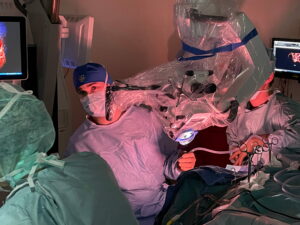
The TITAN laboratory was established in 2023 within the Adolphe de Rothschild Foundation Hospital in Paris as part of the development of research in innovative cortical electrophysiology at Université Paris Cité, within the Integrative Neuroscience & Cognition Center (UMR 8002 CNRS).
The aim of the laboratory is to enable neural decoding of mental representations and to digitally predict brain activity in order to develop brain–machine interfaces for compensating neurological disabilities, as well as to create digital brain models useful for precision medicine.
To achieve this, it is necessary both to develop new cortical recording techniques and new artificial intelligence approaches for analyzing these recordings.
New way to record the brain
The first axis, focused on technological innovations in brain recording, addresses a key question: what is the optimal scale for recording brain activity for neural decoding?
Should we record individual neurons, small local groups of neurons, or distributed populations across the brain?Should we measure activity layer by layer within a cortical column, or instead capture the global activity of many cortical columns? Should we favor highly precise but invasive recordings, or broader but less precise non-invasive methods?
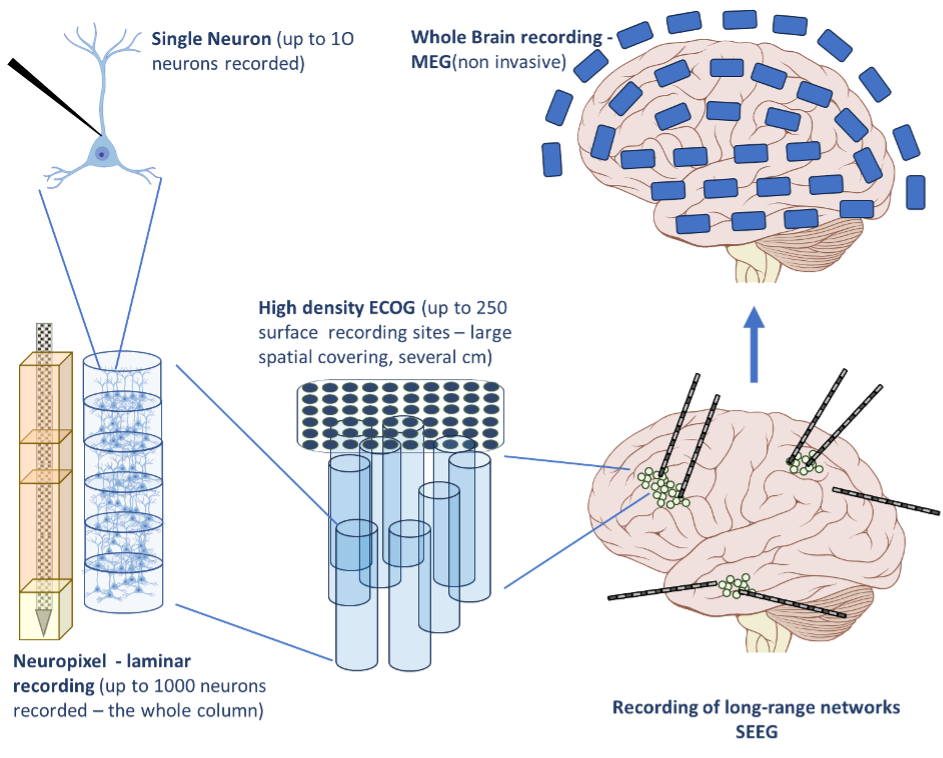
These questions have led us to develop a platform that, in humans, provides access to all these types of recordings in a single setting:
■
■
■
■
Innovative artificial intelligence techniques
The second axis focuses on the development of innovative artificial intelligence techniques for analyzing these data. One major theme is neural decoding—the ability to predict or reconstruct a mental representation based solely on brain recordings. This work spans various types of mental representations, including auditory-verbal, visual, and motor, and across all stages of brain development. Another theme, directly stemming from the first, consists of reversing the model’s inputs and outputs and adapting it to predict brain activity based solely on an external stimulus. The goal is to create a model capable of emulating brain activity.
The potential applications of this research include:

