
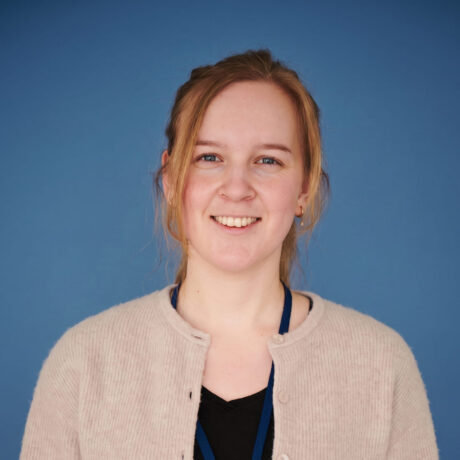
Linnea Evanson is a postdoctoral researcher in AI and Neuroscience at the Hospital Foundation Adolphe de Rothschild (Paris), where she is part of the BrainAI team led by Dr. Jean-Rémi King and Dr. Pierre Bourdillon. Her work sits at the intersection of artificial intelligence and the neuroscience of language, with a current focus on building foundation models for intracranial EEG (iEEG).
She completed her PhD at the École Normale Supérieure (2021–2024) under the supervision of Dr. Pierre Bourdillon and Dr. Jean-Rémi King, funded by the Marie Skłodowska-Curie Actions COFUND fellowship (AI4theSciences). Her doctoral research, entitled "Language Acquisition in Brains and Algorithms", investigated how language representations emerge and evolve across development, using both neural recordings and deep learning models. She also undertook a research internship at Meta AI (FAIR, Paris) in 2022, which led to a publication at ACL 2023.
Prior to her PhD, she earned a first-class MEng in Biomedical Engineering from Imperial College London (2016–2021), and spent a year working in client innovation and data science at Accenture, London in 2020. Her interest in deep learning dates from the time of her masters thesis when she authored a paper on biomimetic computations for neural network robustness.
Linnea works at the intersection of artificial intelligence and neuroscience, combining machine learning with the study of how the brain processes and acquires language. Her work spans the full arc from raw neural signals to high-level computational models, with a particular focus on building and applying large-scale AI models to brain data.
She has broad experience in deep learning, natural language processing, and neural decoding, and brings an interdisciplinary perspective shaped by training in biomedical engineering, cognitive science, and AI. She has contributed to open-source scientific software and has industry experience from her time at Meta AI and Accenture, as well as research experience in ethical AI at Oxford Brookes University.
Linnea's research agenda over the coming years centers on understanding the similarities and differences in how the brain encodes, maintains, and develops language - and how AI systems do.
